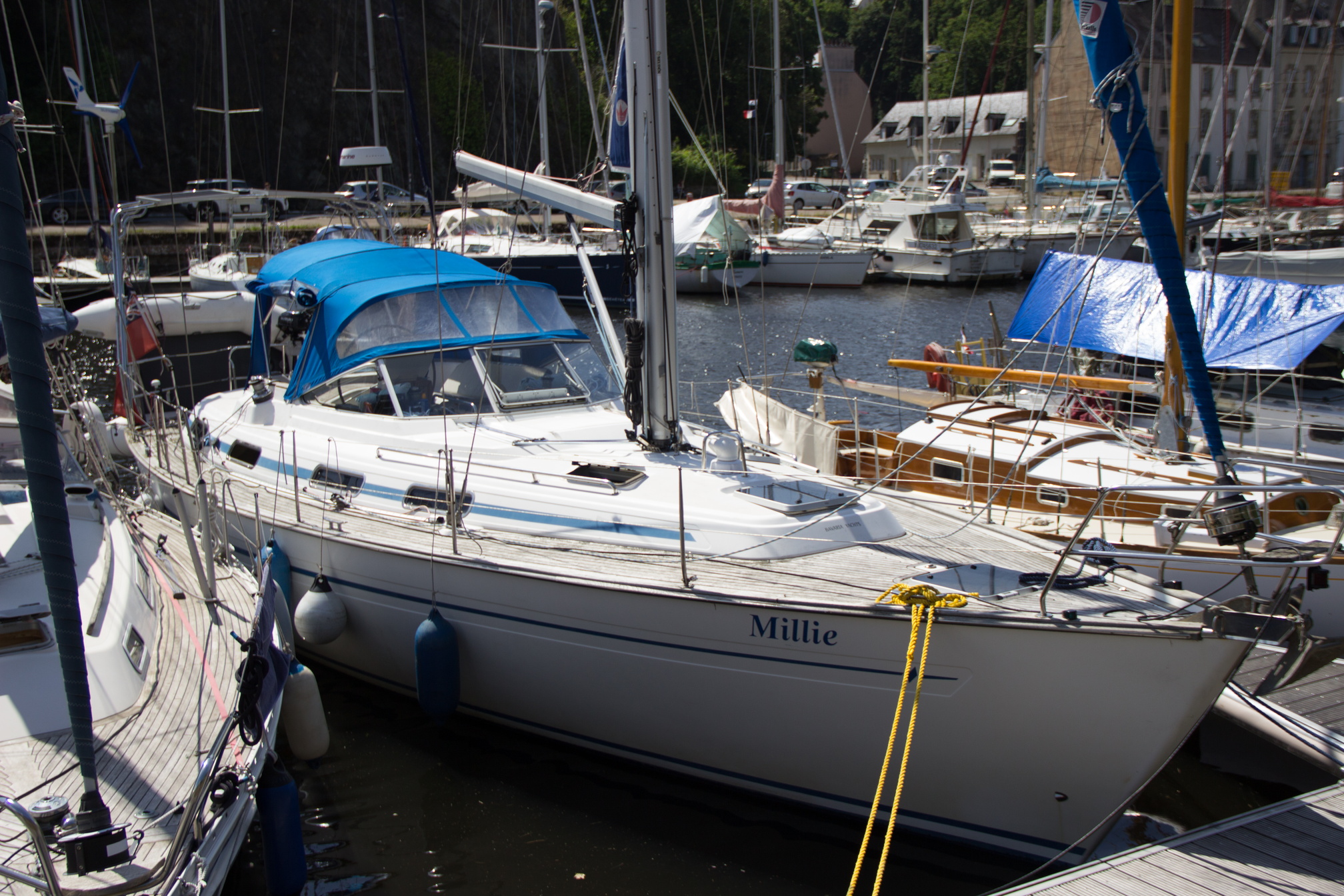
It was getting dark and the visibility was closing down as the earlier haze turned to a thick mist. We were approaching the rocky shoreline east of the Lizard and we had to make a decision. If we got it wrong, we could be appearing on Saving Lives at Sea.
Fifteen hours earlier we had been waiting in the lock to leave Morlaix, on the north coast of Brittany, on a bright sunny morning. This was the last leg of a trip that had seen us leave the Deben in Suffolk a month earlier. After working our way around the English coast as far as Poole, we gave in to the westerly winds and took a leg across to St. Peter Port and then to Lezardrieux and along the Brittany Coast.
Coming up the river to Morlaix had been interesting! I had called the helpful harbour master earlier in the day and he confirmed we’d have enough water for our 2m draft, but emphasised that we should look out for the leading marks in the river and make sure we stayed on track. As we entered the narrower part of the river we were following a Canadian boat, but at this stage the course was well marked with red and green buoys. Then the buoys ran out and we spotted in the bushes ahead the first leading marks. Then the Canadian boat came to a sudden halt, which was a concern, but they seemed to be a little off line. I felt bad that we couldn’t help them, but I really couldn’t see how we could get a rope across to them without going aground ourselves – and the tide was still coming in, so with luck they should get off. We followed the next set of leading marks without incident, and then I saw a red buoy up ahead and started heading straight for it.
Now it was our turn to come to a halt as our keel stuck in the soft muddy bottom of the river. Full astern had no effect whatsoever, but as east coasters we had experience of muddy bottoms! By alternating forward and reverse, and using the rudder I was gradually able to swing Millie around and work towards the deeper water to our left and finally break free, leaving a substantial cloud of blue smoke drifting across the river. Only then did we see the last set of leading marks, almost invisible against the backdrop of a boatyard. Finally we made it to the lock as the harbour master set off down the river in his RIB to rescue our Canadian friends.

We spent four days in Morlaix waiting for a weather window to cross to Cornwall where we had booked a mooring for the rest of the summer.
Heading down the river that morning I knew it would have been more sensible to leave later so that we arrived on the Cornish coast in daylight, but it seemed a waste to sit around at anchor for half a day in good weather when we could be on our way. As we left Roscoff to port, there was a perfect westerly 4-5 and the weather was clear. We had a good crossing and by 9pm we were about 16 miles east-south-east of the Lizard. As the light began to fade, I was surprised that we couldn’t pick up the Lizard light, but by now the wind had dropped, and so had the visibility.
Millie is well equipped with chartplotters, AIS and radar, so I wasn’t too concerned at first, but I was conscious that it wouldn’t be wise to try to enter Falmouth harbour in the dark – a port I had never been into before. The Helford river had been on my mind as a possible anchorage, but again it may not be easy in the dark with poor visibility. After studying the chart I decided we had two options: stand out to see until it got light – but with poor visibility I wasn’t keen – or close in on the coast and drop anchor. The latter seemed like the better choice, particular with the calm conditions, but there were still risks such as fishing buoys and rocks.
After studying the chart I picked a bay north of the Helford entrance that appeared to have a gently shelving bottom. I decided not to go to close inshore, but to head in until we were in about 10m of water and then drop the pick. By this time we were motoring and as it got dark I reduced speed to about 3 knots, and Elizabeth sat up on the side of the cockpit keeping a look out – not that she was able to see very much. I kept the autopilot on so that I could concentrate on the chart plotter and radar screen. The echoes on the radar confirmed our position relative to the coastline, so that gave me confidence in our navigation, but it was a concern that we couldn’t see any lights. By now we were abeam of the Manacles and just half a mile off. Elizabeth spotted a light, probably a car’s headlamps, so not all that helpful.
A large echo was beginning to appear on the radar in front of us, but no AIS from it. It could only be a ship, but it didn’t appear to be moving, so probably at anchor. I altered course to give it a wide berth, but we didn’t actually see it. Finally we could turn in towards the coast, and the depth started to reduce. We got the anchor ready, and as planned, we dropped it in 10m, off Maenporth beach. Occasionally some dots of light appeared through the murk, but it was difficult to get any sense of where we were. But, apart from a slight swell, the sea was calm and there was no wind, so having made sure the anchor was holding fast, we finally went to bed at 2am.
I got up briefly at first light but all was calm and with thick fog, nothing to be seen. We hadn’t moved so I returned to bed for a few hours. In the morning the mist began to clear a little and we eventually saw the coastline, a few other boats anchored much closer into the shore and the anchored ship we had dodged in the dark. It was not until 11.30 that morning that the visibility had cleared enough to finally motor in towards Falmouth and our new mooring at St. Just.


More photos from our 2024 cruise at Millie Cruising 2024