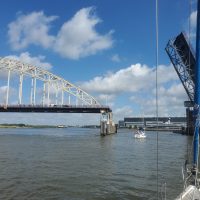
After the peace and quiet of the Grevlingenmeer, we headed north, through the busier waterways of the Rhine and Maas (or Meuse) delta. First there were some major dams and bridges to get through – including the scary ones where we only have about a metre of clearance at the top of the mast. Our ‘air draught’ is about 17.5m and the clearance was 18.5. From below that looked mighty close!
After an overnight at the quiet marina of Dintelsas (and a very good meal at the restaurant in the marina) we headed to the old town of Willemstad where we stayed for two nights – partly because of the spell of wet weather that came through.

Then onward to Dordrecht – or ‘Dort’ as the locals call it. Dordrecht is an old trading city at the junction of the Rhine and Maas, with easy connections out to sea. We took a marina berth in the Nieuwe Haven (New Harbour) – which was built in 1410, although I suspect the marina pontoons were a little more recent. It’s a lovely old town and the marina was right in the heart. We decided to stay an extra night to explore further.


In the morning we took our bikes on the waterbus across to the famous Kinderdijk – apparently they have windpumps in Holland as well as in Norfolk. (And I can say Holland here, as we are in the region of the Netherlands called South Holland). The watery landscape would seem very familiar to anyone from the Broads – lots of reed, coots, grebes and herons. It was only spoilt by the large guided parties of tourists from cruise boats and bus tours. But being on a bike was the perfect way to enjoy it. There was a cycle path down the entire length of the dyke (about 3km) and as we got away from the visitor centre we quickly left the tour parties behind. Our ride then took us back through rural countryside (lots of goats!) and across a railway bridge to the Biesbosch visitor centre. By this time it was raining quite hard, so we didn’t see much of this (again familiar) watery landscape, but took refuge in the cafe for some lunch before catching the waterbus back to the town.

Almost all of our ride was on dedicated cycle paths. The Netherlands generally seems to give priority to space for cycling and public transport – and no extra charge for taking your bike on the waterbus. The UK will never see cycling more widely adopted until we stop wasting money on painting useless cycle lanes on the sides of roads and give priority to safe, separated cycle ways.
We are now in the centre of Rotterdam and again the priority given to cycling and public transport is impressive. All the roads seem to have dedicated cycle lanes, either completely separated from major roads, or given priority on side roads. On the stunning Erasmus Bridge, built in the nineties, there is only a single lane in each direction for cars, but there are also tram tracks and bike lanes in each direction. The city is amply served by trams, plus two high speed underground metro train routes, running north-south and east-west.
Rotterdam is a busy, modern city, a financial and commercial centre, but also has glimpses of it’s history and some stunning architecture and open spaces. Well worth a visit, although perhaps not for too long!


