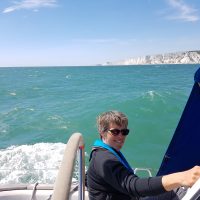
Over the last few days we’ve visited Fecamp, Le Havre and Honfleur in the mouth of the Seine, and we are now in Eastbourne having crossed the channel from Fecamp.
Of all of these places, Le Havre was the most surprising. We hadn’t really intended going into Le Havre as the marina is on the edge of this large city port – think Portsmouth or Southampton – and it didn’t appeal. But what we found was a clean, modern city with lots of attractive features and good restaurants. Compared to some of the places we’ve been it seemed quite wealthy. As with much of this coast, large parts of the city were completely destroyed during the war, but unlike other places, Le Havre’s reconstruction was layed out by architect Auguste Perret, who also led the design of much of the rebuilding. The result is block after block of similar, but quite attractive, apartment blocks, 5 or 6 stories high using a modular concrete system. As a result the city was designated a world heritage site by Unesco in 2005. It also has renowned natural history and modern art museums, although we didn’t have time to visit.


The marina in Le Havre is huge and sailing and fishing are obviously popular local pastimes. The visitor’s berths were right on the outside of the marina and it was a good 5 minute walk to get ashore to the toilet block etc.
Honfleur is completely different. The old buildings around the harbour appear to have been largely untouched by the war and it has become a huge tourist trap. We were there on the day France played Argentina in the World Cup, and every bar around the harbour had a large screen TV showing the match. Every time France scored there was a huge roar and honking of horns. Fortunately France won 4-3 and everyone was very happy.

We didn’t take Millie into the old harbour right in the centre as we thought it might be too noisy. Just outside there is a visitor’s pontoon next to a public park, which was very pleasant. I found the place just a bit too busy – despite the huge number of restaurants it was difficult to find anywhere to eat – but it might be nice to go back at a quieter time of year.
Fecamp is a moderate sized port town to the north of Le Havre – a largish marina, some fishing boats – and also a small seaside resort. The coast here obviously has two very different geologies. East of Cap d’Antifer (just north of Le Havre) the coast is characterised by chalk cliffs and small pebbly beaches. To the south west, the cliffs become sandstone and the beaches sandy. Strangely when we were there it also seemed to be about 10 degrees warmer – perhaps because of the north easterly wind direction. The result seems to be that the seaside resorts to the north east are generally poorer than the smarter resorts of the Seine Bay, such as Deauville and Trouville.
Fecamp’s main claim to fame seems to be that it is the home of Benedictine, the french liquer. The story is that it was originally created by Benedictine monks and the recipe lost after the French revolution, to be rediscovered in the 19th century by Alexandre Le Grand, a local wine merchant, although it is more likely he invented the recipe himself. He built the ‘Benedictine Palace’, a huge Victorian (or whatever the French equivalent is) gothic pile where they still produce the drink.

Returning from Fecamp we sailed most of the 70 miles across the Channel to Eastbourne in a stiff Force 4-5 North Easterly. Close hauled all the way we made good time, leaving at first light (about 4am UK time) and arriving around 4pm.


Sovereign Harbour at Eastbourne is a huge spread out marina with massive housing development all around. The marina is unusual in several ways: it has two locks, alternately used for in and out; it has a commercial fishing quay within the marina complex; and it has four distinct sections, linked by channels with automatic lifting bridges. As part of the complex there is a line of, mostly chain, restaurants and a retail park next door has an Asda, Boots, Next, TK Max, Sports Direct etc.
The bikes came in handy here as the distances around the marina are quite considerable. I had a pleasant morning ride in towards Eastbourne where there is a cycle track running along the promenade – until you get towards the centre where there are big ‘No Cycling’ signs and you have to join a busy and quite narrow road. When will planners recognise that cycle routes need to be joined up to be useful and not just dump you in the middle of busy traffic?
Anyway, now we’re heading east towards Dover. I suspect we’ve quite a lot of motoring ahead as the wind is on the nose and forecast to get lighter.