or how to build a non-magnetic extension speaker…
Our main VHF set, as with many boats, is by the chart table, and I also have a handheld I can use in the cockpit, which is useful to talk to port operations and marinas. But it is considered seamanlike to monitor channel 16 and port operations, and I don’t want to have the handheld knocking around the cockpit all the time.
Simple I thought, I’d put an extension speaker in the steering console, where I can hear it while helming. Bad mistake. The main steering compass is now reading 20-30 degrees off!
So what’s the solution? I like having the speaker there, I can hear it clearly without it being so loud as to be annoying. Searching on the internet for non-magnetic speakers, or “compass safe” came up with nothing, but Wikipedia did suggest an alternative technology: piezo electric speakers.
I’m not going to go into detail of the technology behind piezo electric devices – suffice to say that no magnets are involved so they should be safe near the compass. A further search didn’t come up with anything that could simply replace the loudspeaker, but it did find some products from Sonitron, distributed by RS in the UK, which look promising. Not only are they non-magnetic, but they’re waterproof and dustproof, so should be no problem in the marine environment (although what the salt will do to them in the longer term is an unknown). The only downside of these is that they need a powered amplifier circuit to interface to the extension speaker output of the VHF, but Sonitron produce ready made (and very compact) modules ready to go.
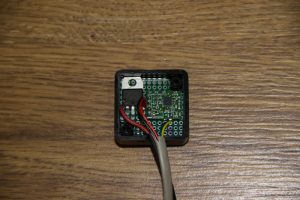
Having tracked down all the parts and made up the board (a bit fiddly as the amp board is very small and I chose to put it in a tiny plastic box!) I installed the speaker in the steering console and the amp next to the VHF set. Amazingly it worked and I can now hear the VHF! I have to admit the quality wouldn’t win any hifi awards, as it loses some of the lower frequencies, but it’s good enough to hear someone calling me on 16 which is the main objective.
Construction
So to make this work we’ll need:


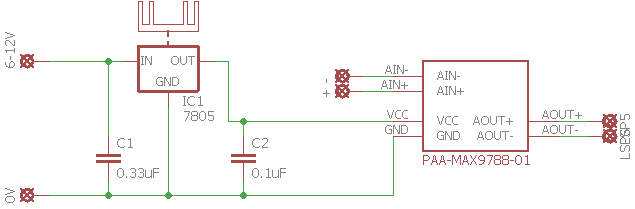
You will also need a couple of capacitors to work with the 7805 voltage regulator (1 x 0.33uF and 1 x 0.1uF) and I used a small piece of perf board and some header pins to mount the components and connect the speaker and power wires. The amplifier board is very small and the perf board can be cut to fit the case more easily. The speaker grill is not essential, but I already had a speaker sized hole to cover and this will keep it tidy and give the speaker module some protection.
Here’s the schematic for the amp circuit: